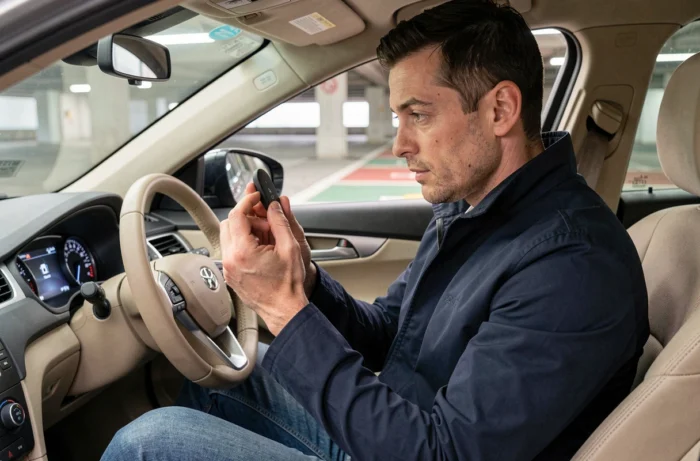
Can a Bluetooth tag slipped into the glove compartment really protect a vehicle from theft, or is it limited to finding lost keys in a parking lot? The answer depends on what is being measured: the accuracy of location, the frequency of updates, and reliability in sparsely populated areas are three parameters that clearly differentiate the Bluetooth tag from the cellular GPS tracker.
Bluetooth Location Chain: What Happens Between the Tag and Your Screen
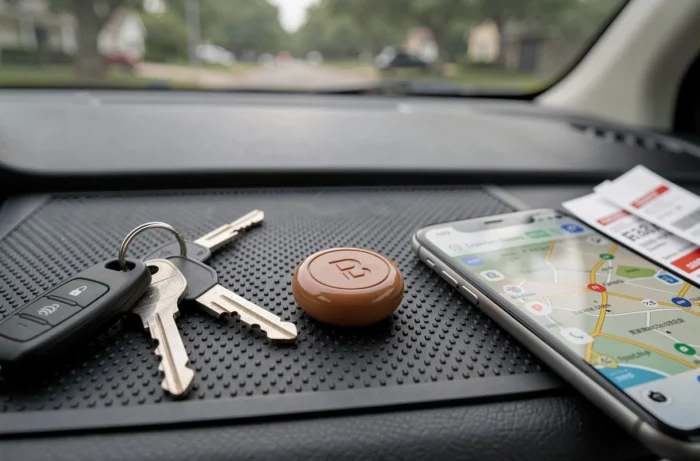
The operation of a Bluetooth tag for cars relies on an indirect principle. The AirTag, for example, emits a Bluetooth signal captured by nearby iPhones and iPads on the Apple Find My network. These devices then relay the position to iCloud, where the owner can view it.
This mechanism involves total dependence on the density of compatible smartphones around the vehicle. In a city center, updates can arrive within minutes. In an underground parking lot or a rural area, the tag can remain silent for hours, due to a lack of nearby relays.
Google applies an additional restriction: its Find Hub network limits location relaying to areas considered very busy, further reducing coverage in a quiet street or isolated parking lot. To better understand these issues applied to the automotive context, you can discover the services of City Automobiles that detail the concrete uses of these technologies.
Bluetooth Tag vs GPS Tracker: Performance Comparison Table for a Car
Before choosing, it is essential to compare the two technologies based on the criteria that matter for a parked or moving vehicle.
| Criterion | Bluetooth Tag (like AirTag) | Cellular GPS Tracker |
|---|---|---|
| Location Mode | BLE signal relayed by nearby smartphones | Integrated GPS receiver, position transmitted via mobile network |
| Position Update | Variable, depends on the passage of compatible devices | Continuous or at programmed intervals |
| Reliability in Isolated Areas | Low (no relay = no position) | Good, as long as the mobile network covers the area |
| Reliability in Underground Parking | Very low | Reduced (weakened GPS signal), but the last known point remains recent |
| Battery Life | About one year (replaceable button cell) | Variable, often a few weeks without charging |
| Subscription | None | Data plan required in most cases |
| Anti-Tracking Alert | Yes (Apple-Google standard since 2024) | Not detected by standard Bluetooth alerts |
The table highlights a structural gap. The Bluetooth tag locates opportunistically, while the GPS tracker operates autonomously. To recover a stolen vehicle moved to a sparsely populated area, the difference becomes critical.
Anti-Tracking Alerts: A Game-Changing Constraint for Bluetooth Tags in Cars
Since May 2024, Apple and Google have deployed a common standard for detecting unwanted trackers. iPhones running iOS 17.5 or later and compatible Android devices now report that an unknown Bluetooth tracker is moving with a person.
This protection was designed to combat harassment. In practice, it produces a collateral effect on anti-theft usage: a thief equipped with a recent smartphone will be alerted to the presence of the tag in the vehicle. They can then make the device ring, locate it, and remove it.
Autonomous GPS trackers, which use the mobile network and not Bluetooth, are not affected by these alerts. This asymmetry weakens the value of a Bluetooth tag as a vehicle recovery tool.
What Alerts Detect and What They Ignore
- Tags compatible with the Apple-Google standard (AirTag, Samsung SmartTag, Chipolo) trigger notifications on nearby smartphones after a certain period of joint movement
- Cellular GPS trackers, which do not emit in Bluetooth Low Energy in a way detectable by this standard, go under the radar of alerts
- Tags from more restricted proprietary networks offer variable detection coverage depending on the number of compatible devices deployed
Compatibility Between Ecosystems: The Trap of Fragmented Network Coverage
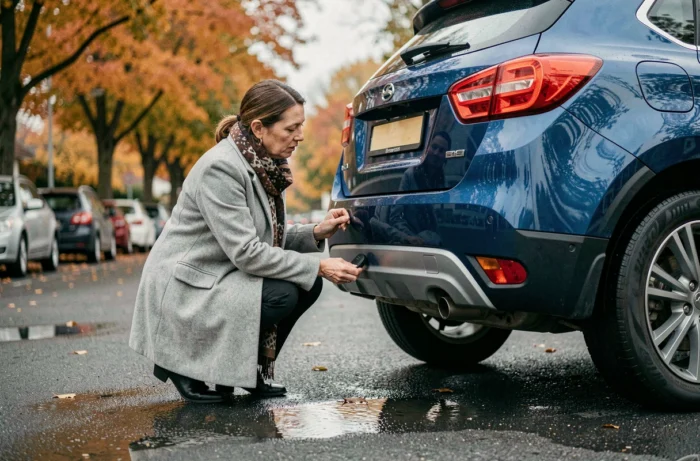
A Bluetooth tag designed for Apple Find My only benefits from nearby Apple devices. An AirTag in a car parked in an area where most passersby use Android will not report a position, even in the city center.
Google Find Hub expands coverage on the Android side, but with geographical restrictions. Position relaying is limited to areas deemed very busy, which effectively excludes a significant number of common parking situations.
This compartmentalization pushes some users to combine two tags from different ecosystems. This approach increases the chances of reporting but doubles the cost and management complexity, without ever achieving the reliability of a GPS tracker that does not depend on the phones of passersby.
Bluetooth Tag for Cars: Cases Where It Remains Truly Relevant
The Bluetooth tag is not useless. Its area of relevance is simply more restricted than marketing suggests.
Finding your vehicle in a large urban parking lot remains its most reliable use: the density of smartphones there is sufficient to obtain a usable position. The absence of a subscription and long battery life make it a low-maintenance accessory for this daily use.
On the other hand, relying on a Bluetooth tag as an anti-theft device exposes one to a double weakness: random coverage in sparsely populated areas and detection by anti-tracking alerts. A cellular GPS tracker, despite its subscription cost, offers autonomous location and escapes Bluetooth detection mechanisms.
The choice between the two technologies comes down to a question of context. For regular parking in a dense urban area, the Bluetooth tag fulfills its role as a marker. For theft protection with real-time tracking, only a cellular GPS tracker guarantees an independent position report from the immediate environment of the vehicle.