
A homeowner starting a bathroom renovation comes across three companies through an online search. Quotes arrive within two days, prices vary widely, and none of the three documents mention the same guarantees.
Before even comparing the amounts, it’s important to check who is behind each SIRET number. Verifying the reliability of a tradesperson before requesting an online quote can save months of disputes and sometimes significant extra costs.
Check the SIRET on the Business Directory, not elsewhere
The classic reflex was to look for a SIREN number on sirene.fr. This site closed on December 2, 2025. Verifications now go through the Business Directory (annuaire-entreprises.data.gouv.fr) and the data from the National Business Register.
A often overlooked point: a company can have multiple establishments. The SIREN number identifies the legal structure, but it’s the SIRET of the establishment indicated on the quote that needs to be verified. An inactive SIRET or one linked to an activity unrelated to the proposed work (different APE code) is an immediate warning signal.
This public record notably shows the creation date, status (active or deregistered), declared address, and main activity. A compliant tradesperson has no reason to refuse to provide their SIRET. If they dodge the question, move on to the next one. To cross-check these verifications with concrete feedback from other individuals, one can rely on the reviews and feedback on welovetravaux.fr available online.

Decennial insurance certificate: what the document must mention
Requesting a decennial insurance certificate is widely recommended. However, correctly reading this document is less common. A valid certificate must specifically cover the activities that the tradesperson will perform on the site.
Details to check line by line
- The validity period: the certificate must cover the start date of the work, not just the date of issue of the quote. An expired or soon-to-expire certificate does not protect the project owner.
- The guaranteed activities: if the quote includes electrical and plumbing work, both trades must be covered. A guarantee limited to major works does not cover a claim on a sanitary installation.
- The name and SIRET of the insured company: they must match exactly those on the quote. Any discrepancy, even minor (old name, secondary establishment), can pose a problem in the event of a claim.
Verifying the decennial insurance directly with the insurer remains the most reliable method. A call or email to the company mentioned on the certificate allows you to confirm that the contract is still active and has not been canceled in the meantime.
Cold calling and energy renovation: a prohibition to know
Since July 1, 2025, the law against fraud related to public aid prohibits cold calling, electronic outreach, and social media contact for energy renovation and housing adaptation work. A tradesperson who reaches out through these channels to offer insulation, boiler replacement, or heat pump installation is acting outside the legal framework.
On the ground, this means that an unsolicited first contact should trigger heightened vigilance. Serious professionals in this field expect the individual to take the initiative or use identified matchmaking platforms.
Feedback varies on this point, as some work brokers continue to contact prospects by phone, presenting themselves as intermediaries rather than tradespeople. The legal nuance exists, but for an individual, the simplest approach remains to prioritize quotes initiated on their own initiative.
Labels, qualifications, and customer reviews: sorting the reliable from the decorative
Verifiable qualifications and self-declared labels
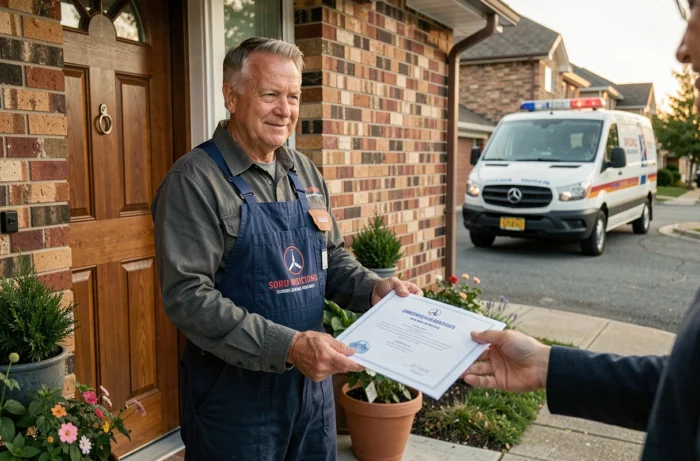
An RGE label (Recognized Guarantor of the Environment) can be verified on the official site france-renov.gouv.fr. A tradesperson displaying RGE without being listed in the official directory is using the designation abusively. Qualifications such as Qualibat, Qualifelec, or QualiPAC work on the same principle: they are searchable online and associated with a certificate number.
Some mentions like “certified tradesperson” or “approved professional” have no regulatory value. They are marketing phrases. One should stick to verifiable labels with a certificate number and a validity date.
Online reviews: reading between the lines
A high overall rating is not enough. Attention should be paid to detailed reviews that describe the course of the project, adherence to deadlines, and handling of unforeseen issues. Very short and uniformly positive reviews (“great job, thanks”) provide little information.
Some useful signals in negative reviews: uncommunicated delays, additional costs added during the project, difficulty reaching the tradesperson after receipt. A reliable professional responds publicly to negative reviews with factual elements, not with a generic formula.
What the quote itself reveals about the seriousness of the tradesperson
Before comparing prices, look at the structure of the document. A complete quote details each item: nature of the service, quantities, unit prices, material references, payment terms, and execution time.
- A global package without itemized details prevents any comparison and any subsequent dispute.
- The absence of mention of decennial insurance on the quote is a failure to meet the professional’s legal obligations.
- An advance payment exceeding a reasonable proportion of the total amount, required before any work begins, should raise alarms.
The quote binds the tradesperson once signed. A professional who refuses to detail their services in writing or who changes the terms after signing does not deserve to be entrusted with a project.
The reliability of a tradesperson is not measured by the quality of their website or the speed of their response. It is reflected in verifiable documents: active SIRET, current decennial insurance certificate, referenced qualifications, and a structured quote item by item. These verifications take about twenty minutes and can save thousands of euros in uncovered defects.