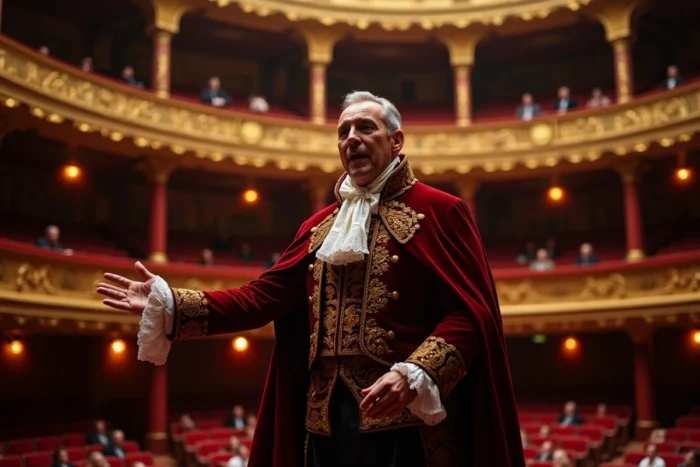
Verdi composed more than twenty operas over nearly six decades. Some return each season in global lyric programming, while others have practically disappeared from the posters. What distinguishes the titles that remain in the repertoire from those that fade away, and how do contemporary stages reinterpret this catalog?
Stravinsky, Rigoletto, and Falstaff: A Reception that Illuminates the Verdi Canon
The legacy of an opera is not measured solely by its frequency of programming. It is also reflected in the admiration it receives from other composers. The Opéra de Marseille reminds us that the two operas of Verdi most cherished by Stravinsky were Rigoletto and Falstaff.
This choice is revealing. Rigoletto (1851) marks the beginning of Verdi’s maturity, with a dramatic structure where each aria advances the action. Falstaff (1893), Verdi’s final opera, breaks away from the tragic model to adopt an almost continuous writing style, akin to musical conversation. Stravinsky saw in it a form of modernity that resonated with his own explorations of rhythm and declamation.
This cross-examination between two opposing aesthetics (Stravinsky’s neoclassicism and Verdi’s romanticism) shows that the relevance of an opera transcends its time of creation. To delve deeper into the question, a detailed overview brings together the emblematic operas of Verdi and analyzes their dramatic specificities.
Popular Trilogy vs. Late Operas: A Repertoire Comparison
Rigoletto, Il Trovatore, and La traviata are often grouped under the label of “popular trilogy,” composed between 1851 and 1853. These three titles share a common grounding in bourgeois or aristocratic drama, immediately identifiable melodies, and vocal roles that have become testing grounds for singers.
The late operas (Aida, Otello, Falstaff) follow a different logic. The orchestra takes on a more structuring role, vocal ensembles become more complex, and the boundary between recitative and aria becomes blurred.
| Criterion | Popular Trilogy (1851-1853) | Late Operas (1871-1893) |
|---|---|---|
| Musical Structure | Closed arias, cabalettas, distinct recitatives | More continuous writing, interconnected scenes |
| Role of the Orchestra | Accompaniment of the singing, frequent doubling | Autonomous dramatic commentary, recurring motifs |
| Subject | Passionate drama, honor, sacrifice | Political tragedy (Aida), jealousy (Otello), satirical comedy (Falstaff) |
| Vocal Demands | Agility, counter-notes, inherited bel canto | Endurance, declamation, dynamic nuances |
| Presence in Lyric Season | Very frequent, often opening the season | Frequent for Aida and Otello, rarer for Falstaff |
This table shows a considerable stylistic gap between two periods separated by less than forty years. Verdi traversed at least three distinct aesthetics within his own career, making any generalization about “the Verdi style” approximate.
Nabucco and the Requiem: Two Pivotal Works in Current Programming
Nabucco (1842) remains a pivotal title in lyric seasons. The Opéra Grand Avignon has included it in its recent programming announcements, and the Capitole de Toulouse has placed it at the season’s opening. The chorus “Va, pensiero” serves as an identity marker, often extracted from its scenic context for commemorative events or outdoor concerts.
The Requiem, although not an opera, extends Verdi’s dramatic thought into a sacred setting. The Opéra national de Nancy-Lorraine presented in 2026 a staged production of the Requiem described as “attraction of chaos,” programmed until June. Verdi’s Requiem now transcends the purely concert format to become a fully staged object.
This trend of staging a liturgical work illustrates a broader movement: opera houses are seeking new forms to attract an audience that does not frequent traditional symphonic halls.
The Challenge of Mediating Verdi’s Titles
The Opéra de Lausanne recently offered an immersive approach to Rigoletto, inviting the audience to discover behind-the-scenes, from the backstage to the stage. This type of initiative responds to a realization: the Verdi repertoire is known for its arias, much less for its dramaturgy.
Several elements explain this approach:
- The most famous arias (“La donna è mobile,” “Libiamo ne’ lieti calici”) circulate out of context, in advertisements or compilations, creating a superficial familiarity with the work
- The Italian language, even for a French-speaking audience, remains an obstacle to dramatic understanding without surtitles
- The duration of Verdi’s operas (often over two hours with intermissions) requires preparation that the immersive format facilitates by creating an emotional connection with the production even before the curtain rises
Verdi Between Bel Canto Heritage and Dramatic Break
Verdi inherited from the bel canto of Bellini and Donizetti. His early operas (Oberto, Un giorno di regno) bear this imprint: ornate vocal lines, predictable structures, primacy of the voice over the orchestra. The break begins with Macbeth (1847), where Verdi demands of Lady Macbeth a “ugly and dark” voice, contrary to the belcantist aesthetic.
This trajectory continues until Otello (1887), where singing becomes inseparable from the scenic action. Iago’s monologue in the second act (“Credo in un Dio crudel”) is no longer a detachable aria: it functions as a dramatic block integrated into the scene.
In contrast, La traviata retains moments of pure lyrical outpouring (the brindisi of the first act) that explain its lasting popularity with non-specialist audiences. The coexistence of these two logics within the same catalog makes the Verdi repertoire adaptable to both a gala evening and an experimental production.
Opera houses programming Verdi in 2026 thus make a choice of interpretation as much as a choice of title. An opening season Nabucco in Toulouse and a staged Requiem in Nancy do not address the same audience but rely on the same foundation: a composer whose work supports multiple angles of interpretation without losing its musical clarity.