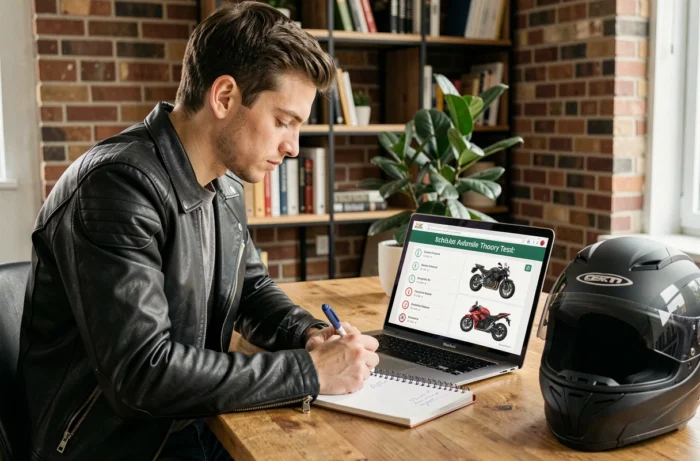
The motorcycle theory exam, or ETM, is based on a question bank distinct from that of the car code. Safety trajectory, specific braking for two-wheelers, motorcyclist equipment: these topics have no equivalent in car training. Kopilote, the application developed by ENPC-Ediser, offers dedicated training for these motorcycle series, accessible as soon as you enroll in a driving school.
ETM motorcycle: themes not covered by the car code
A candidate who has already obtained their B license might think that the motorcycle theory part will be a formality. The ETM questions focus on situations specific to riding two-wheelers, rather than simple variations of automobile traffic rules.
Among the specific blocks, we find the safety trajectory in curves, positioning on the road in front of an obstacle, or braking distances adapted to the weight and grip of a motorcycle. Questions about equipment (certified gloves, back protectors, helmet standards) come up regularly.
This is where targeted training makes sense. Working solely on general series leaves blind spots on subjects that represent a significant part of the exam. Kopilote structures its series around these motorcycle blocks, allowing them to be identified and worked on one by one rather than being randomly mixed in a global quiz.
Before diving into the training series, it is useful to understand how the platform works. Several candidates choose to train for the motorcycle code on Kopilote because the application functions both as a response device in the classroom and as a self-study tool on a smartphone.

How Kopilote works for motorcycle code preparation
Kopilote is provided by the driving school at the time of enrollment. The student receives a username and password that grant access to the mobile application and the web platform. The tool serves two distinct functions.
In the classroom
The application acts as a connected response device. The student answers the series projected in the classroom, and their results are recorded in their profile. It’s the same system as the old physical remote controls, but integrated into the smartphone.
In self-study
Outside of classroom sessions, Kopilote provides access to online training series. The candidate can launch quizzes from any connected device. The series are from the National Driving License Editions (ENPC), which means that the training questions follow the same format as the official exam.
The application offers a progress tracking system. Each completed series feeds into statistics by theme, allowing users to identify categories where the error rate remains high. This point deserves attention, as this is where the training method makes a difference.
ETM revision method: leveraging progress tracking
The classic temptation is to continuously cycle through complete series. This approach produces a reassuring overall score but masks weaknesses on specific themes. Kopilote displays results by category, and this granularity should be utilized.
- After each series, identify the two or three themes where errors are concentrated (often specific motorcycle signage, priority rules at intersections for two-wheelers, or questions about blood alcohol levels and their effects on balance)
- Re-launch short series focused on these themes rather than a new random series of forty questions
- Space out sessions: two twenty-minute sessions per day yield better results than a single hour-long session, as memorization of tricky answers decreases with fatigue
The main trap remains the confusion between a high score and actual mastery. A candidate who consistently scores more than thirty-five correct answers out of forty can still fail if their five errors consistently fall within the same thematic block. The category tracking by Kopilote is precisely designed to detect this pattern.

Registration for the ETM and organizing the revision schedule
The ETM can be taken as a free candidate at an accredited exam center. Registration is done online, but it requires a NEPH number (Harmonized Prefectural Registration Number), obtained through a request on the ANTS website. Without this number, no exam seat reservation is possible.
A point often overlooked in planning: the validity of the ETM is five years. This means that a candidate can take the theory well before starting motorcycle driving hours, without risking their result expiring during practical training.
This validity period changes the preparation logic. Rather than compressing revisions into a few weeks before a plateau exam, it is possible to work on the motorcycle code on Kopilote at a regular pace, then book the ETM exam once the scores by theme are stable.
Limitations to know before the exam
User feedback on the App Store gives Kopilote a relatively low rating. Several candidates report discrepancies between the wording of training questions and those encountered on exam day. The available data does not allow for precise measurement of this gap, but it is better to complement Kopilote training with a review of the thematic sheets provided by the driving school.
- ETM questions evolve: new situations related to approved equipment appear in the official bank
- Kopilote does not always cover the most recent updates at the time of their publication
- Taking a classroom session with commented corrections by an instructor remains a useful complement to online series
Online training on Kopilote provides a solid foundation for preparing for the ETM, as long as one does not limit themselves to accumulating series without analyzing their mistakes. Targeting weak themes, spacing out sessions, and checking the stability of scores by category before booking an exam date remains the most reliable method to avoid unpleasant surprises on the day.