
Choosing an art preparatory course first means confronting an opaque market. Private schools display success rates for entrance exams to art schools, but no public data allows for verification or comparison of these figures between institutions. Unlike health or business tracks, where open databases are beginning to document the effectiveness of preparatory courses, the artistic sector remains without a common reference.
Before committing to a year of training, it is essential to know what to measure and on what criteria to base your decision.
Public or private art prep: what the available data allows us to compare
The first structuring choice concerns the status of the preparatory course. The differences are not limited to tuition fees.
| Criterion | Public Prep | Private Prep |
|---|---|---|
| Access | Parcoursup (wish data available) | Often outside of Parcoursup |
| Annual Cost | Low to none (depending on the institution) | Variable, several thousand euros |
| Transparency of Results | Partial (Parcoursup data) | Self-reported, unverifiable |
| Format | Full-time, complete year | Full-time or hybrid (evening classes, weekends) |
| Student Status | Yes (access to CROUS, transport discounts) | Yes in some cases, including in hybrid format |
The published Parcoursup data allows for consultation of the number of wishes made for public preparatory courses and to assess their relative attractiveness. In contrast, private preparatory courses outside of Parcoursup do not appear in any open database. As detailed in articles published on Les 4 Vérités, this asymmetry of information complicates comparison for candidates and their families.
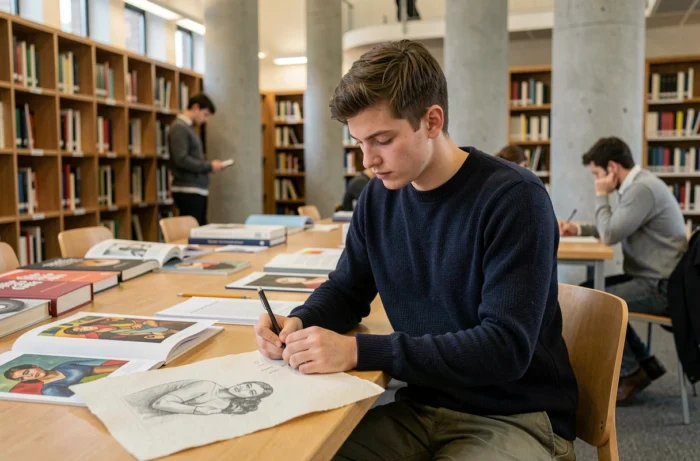
Hybrid formats in art prep: a still little-known option
Several institutions now offer part-time art preparatory courses, in evening classes or on weekends. This format caters to a variety of profiles: high school seniors wanting to test their orientation, students engaged in another field, employees in retraining.
Hybrid formats allow for obtaining student status, with associated benefits (access to CROUS, transport discounts). This point is rarely mentioned in guidance guides, even though it can significantly impact the real cost calculation of a year in prep.
The main interest of these courses lies in reducing risk. Committing an entire year and a significant budget to an art prep represents a heavy commitment. The hybrid format allows one to validate their interest in workshop work, drawing practice, and portfolio building without interrupting another course of study.
Portfolio and artistic file: the real selection criteria for art schools
The portfolio remains the central piece of any application to a higher art school. The prep primarily serves to build it in a structured environment, with regular feedback from practicing teachers.
A solid artistic file is not just a stack of productions. Admission juries evaluate several dimensions:
- The coherence of the creative journey: the works presented must show progression and a common thread, not a series of unrelated techniques
- The diversity of mediums explored: drawing, volume, color, photography, digital creation. A generalist prep encourages stepping out of one’s comfort zone
- The ability to articulate one’s choices: during the admission interview, the jury expects the candidate to explain their intentions, references, and doubts with precision
The art prep structures this work over a year. Practical workshops alternate with art history and visual culture classes, which enrich the discourse around the portfolio.
Admission interview in art school: what makes the difference
The oral interview weighs as much as the file in most schools. Juries look for an assumed uniqueness, not a fabricated posture. Discussing a personal project while showing that one has experimented, failed, and tried again creates more impact than a smooth discourse about one’s “passion for art.”
Preparing for this oral in real conditions, with simulations in front of professionals, is part of the program of most preparatory courses. It is an exercise that requires practice: structuring a few minutes of speech around three or four pieces from the portfolio, anticipating questions about one’s artistic choices, staying concrete.

Art prep and Parcoursup: navigating between the two admission circuits
Some art preparatory courses are listed on Parcoursup, while others operate with their own application schedule. Crossing the two circuits increases options without making them incompatible.
For programs registered on Parcoursup, wishes follow the national calendar. Preparatory courses outside of Parcoursup, mostly private, often open their registrations earlier in the year. Applying to both in parallel allows for securing a spot while aiming for a more selective institution.
- Check if the targeted prep is on Parcoursup or off-platform, as response times and confirmation procedures differ
- Prepare your artistic file from the first term of senior year to avoid being caught off guard by the deadlines of private preparatory courses
- In case of refusal on Parcoursup, the complementary procedure remains open and some preparatory courses participate in it
The absence of a unique reference to assess the quality of art preparatory courses makes the choice difficult. Comparing actual outcomes, the number of students admitted to recognized higher art schools, and the educational content (proportion of hours in workshops, portfolio supervision) remains the most reliable method, even if the data remains patchy.
Choosing an art prep involves a year of intense work and a variable financial investment. In a sector where transparency is lacking, cross-referencing sources, visiting workshops during open days, and questioning former students about their paths after prep constitute the best filter before committing.