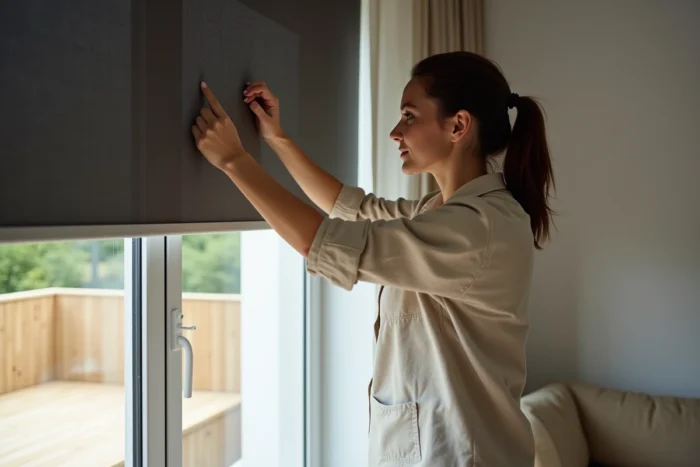
A room bathed in light at six in the morning, an overheated desk as early as June, a projector unusable in broad daylight: the need to block light from a window goes beyond comfort. It affects sleep, indoor temperature, and even the preservation of certain objects.
The choice of a window light blocker primarily depends on where the barrier is placed, the level of darkness desired, and the thermal constraints of the dwelling.
External or internal shading: a performance difference rarely measured
Have you ever noticed that a room stays warm despite thick curtains being closed all day? The problem lies in the position of the barrier. When a blind or curtain is located inside, solar radiation has already passed through the glazing. Heat is trapped between the glass and the fabric, then diffuses into the room.
Placing the shading outside the glazing (roller shutter, adjustable sunshade, vertical awning) blocks radiation before it reaches the glass. Energy renovation specialists and several local authorities are now incorporating external solar protections into heatwave response policies, precisely for this reason.
If you are looking for a window light blocker that combines darkness and coolness, the question of position (interior or exterior) should come first. A well-fitted roller shutter provides nearly total shading and a thermal barrier that interior solutions alone cannot match.
In a co-owned property or a listed building, installing an external protection may be prohibited or subject to authorization. In this case, interior solutions become the default choice, but they must be selected carefully to limit overheating.
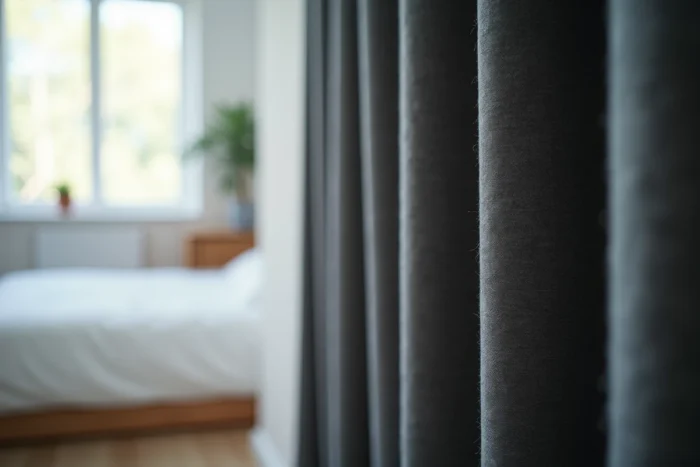
Blackout blinds, thermal curtains, solar films: selection criteria room by room
Each interior solution has an area where it excels and another where it disappoints. Rather than listing all options, let’s focus on the three most common families and the concrete situations that guide the choice.
Blackout roller blind for bedroom and office
The blackout roller blind uses an opaque fabric, often double-sided (white layer on the glazing side, colored layer on the room side). When properly installed with side rails, it nearly eliminates all light entry from the edges. This is the most suitable solution for a bedroom that needs to remain in total darkness, especially for night workers or young children.
Why not a blackout curtain in this case? Because the curtain allows light to enter from the top, bottom, and sides. The roller blind, mounted as close to the window frame as possible, significantly reduces these light leaks.
Multi-layer thermal curtain against summer heat
So-called “thermal” multi-layer curtains are gaining popularity. Some incorporate a metallic layer (sometimes called “Sun Reflect”) that reflects part of the infrared radiation. Tests reported by French mainstream media indicate a reduction in heat entry of around 50 to 60% for the most efficient technical fabrics.
This type of curtain is well-suited for a living room or common area where you want to filter heat without plunging the room into complete darkness. It easily combines with a sheer curtain to maintain brightness in the morning.
Adhesive solar film for fixed windows or Velux
The solar film adheres directly to the glazing. It comes in mirror (reflective), frosted (opaque), or tinted versions. Its advantage: it takes up no space and works on roof windows or fixed bays where a blind would be difficult to install.
Limit to know: a very opaque film also reduces natural light year-round, including in winter when it is needed. A solar film is a relevant choice for a window facing south or west, but rarely for a north-facing window.
Thermal insulation and shading: two functions not to be confused
Many products mix promises. A “blackout and insulating” curtain does not replace efficient double glazing. Shading concerns visible light. Thermal insulation concerns the transfer of heat through the glazed wall.
- A blackout blind blocks light but, when installed inside, only partially reduces the heat transmitted by the glazing.
- A multi-layer thermal curtain mitigates radiant heat thanks to its reflective layer, but its insulating power remains limited compared to a closed external shutter.
- A reflective solar film acts on radiation before it penetrates the room, bringing it closer to the principle of external shading, but it does not insulate from winter cold.
For a dwelling equipped with single glazing, combining interior protection with the gradual replacement of windows remains the most effective strategy. In the Principality of Monaco, a ministerial decree from 2025 (n° 2025-407) has raised aid for window replacement to 600 euros per window for the first five, with a doubled overall ceiling, illustrating the growing importance placed on the combination of joinery and shading for summer comfort.
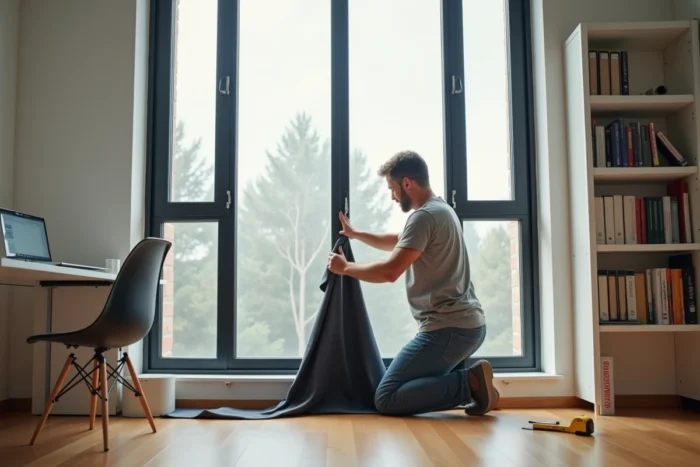
Common mistakes when choosing a blackout blind or curtain
Before buying, check these often-overlooked points:
- Measure the space between the window frame and the wall: a roller blind installed too far from the glazing allows light to pass in from the sides. Side rails or a cassette blind solve this problem.
- Check compatibility with ventilation: a blind pressed against a tilt-and-turn window prevents nighttime ventilation. Plan for a system that allows for partial opening.
- Do not choose a product solely based on its color: the color on the glazing side influences the heat absorbed. A white or silver backing reflects more than a black backing.
- Ignore side returns on a Velux roof window: without a side guide, the fabric peels away and light filters in from the edges, making the blind almost useless.
The choice of a light-blocking device for a window ultimately comes down to three trade-offs: position (exterior or interior), desired level of darkness, and heat management. A blackout blind with side rails covers most needs in a bedroom. A multi-layer thermal curtain is better suited for living spaces. And for windows where none of these options are feasible, solar film remains a discreet and functional alternative.