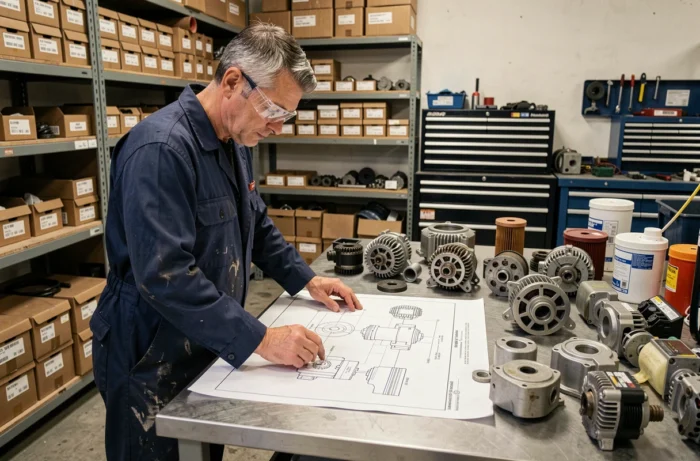
When an SDMO generator refuses to start or loses power, the first instinct is often to look for the faulty part. Without knowing where it is located in the machine, one orders blindly. The exploded view exists precisely to avoid this deadlock: it breaks down each sub-assembly into a readable diagram, with numbered markers linked to spare part references.
However, one must know how to read it, and above all, ensure that it corresponds exactly to the version of your device.
Identifying a Rehlko rebadged SDMO generator before ordering parts
You may have noticed that the SDMO brand has gradually been integrated into the Rehlko group (formerly Kohler Power Systems). This brand change is not just a commercial detail. It has direct consequences on the technical documentation and the references for spare parts.
A generator purchased a few years ago under the SDMO label may now appear in catalogs under the Rehlko name, with a new nomenclature. The machine reference engraved on the nameplate remains the only reliable marker. It is what allows you to find the correct exploded view, even if the brand name has changed in the meantime.
Specifically, before ordering anything, note down three pieces of information about your device:
- The complete serial number, often on a metal plate riveted to the chassis or hood.
- The model designation (for example, Perform 3000, Technic 7500, or a reference from the diesel range).
- The type of integrated engine (Honda, Kohler, Lombardini, or other), as the same SDMO model may have been equipped with different engines depending on the vintage.
This step may seem obvious, but field feedback shows that accurate identification remains a major friction point when ordering. The same model may have evolved over time, with internal components modified from one series to another. Ordering an air filter or a voltage regulator “for SDMO Perform 3000” without specifying the version risks receiving an incompatible part.
To access the documentation that truly corresponds to your machine, a dedicated guide to the exploded view and spare parts for SDMO generators details the search method by reference and series.
Reading an SDMO exploded view: markers, numbers, and disassembly logic
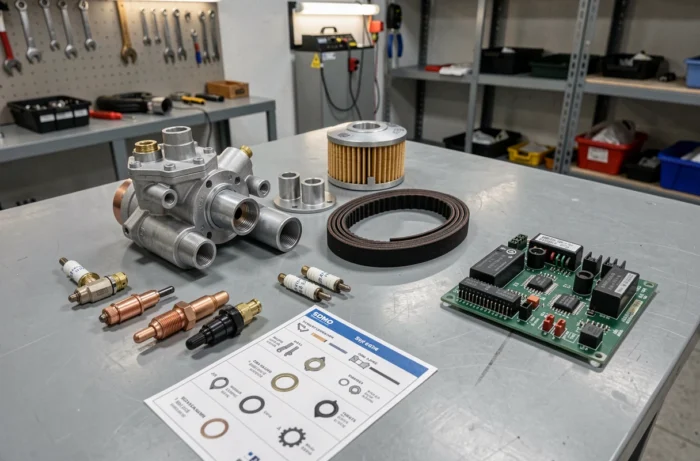
An exploded view is not just a simple technical drawing. It is a diagnostic tool as much as an ordering tool. Each part is represented in its actual position relative to the others, with a marker number that refers to a catalog reference.
Let’s take a concrete example. You suspect a faulty capacitor on a gasoline generator. On the exploded view of the alternator section, you locate the capacitor by its number (let’s say marker 12). This number gives you access to the exact part reference, but it also shows you which elements to remove to access it: the protective cover (marker 3), the wiring support (marker 8), etc.
The exploded view guides disassembly in the reverse order of assembly. By following the markers from the outside in, you avoid forcing a component still attached to another.
Priority areas to identify
On an SDMO generator, the exploded view is generally divided into several distinct sheets:
- The engine block (starting system, filtration, cooling circuit).
- The alternator and its voltage regulation.
- The chassis, the tank, and soundproofing elements if applicable.
- The control panel and electrical wiring.
Each sheet covers a self-contained sub-assembly. Starting by identifying the correct sheet avoids searching for a cylinder head gasket on the alternator diagram. This seems logical, but when you’re a beginner, all the sheets look alike.
Original parts, adaptable parts, and actual compatibility
The question of the origin of parts comes up systematically. Should you exclusively buy parts stamped SDMO or Rehlko, or can you turn to adaptable parts?
For engine components (filters, spark plugs, belts), the answer depends on the engine manufacturer. An SDMO generator equipped with a Honda engine uses Honda parts, not specific SDMO parts. The exploded view confirms this: the marker for the oil filter refers to a Honda reference, not an SDMO proprietary number.
Parts that are truly specific to SDMO concern the alternator, the AVR regulator, and the chassis. These are the components that should be sourced from the Rehlko network or specialized distributors. For the rest, the engine dictates compatibility.
The trap of rebadging on electrical parts
With the transition from SDMO to Rehlko, some references for electrical parts have changed without the physical component being modified. A voltage regulator may carry a new catalog number while being strictly identical to the old one.
Conversely, a retained reference may mask a technical evolution (modified connectors, adjusted voltage range). Cross-referencing the marker number on the exploded view with the manufacturing date of your generator remains the only reliable verification.
Fault diagnosis guided by the exploded view: practical method
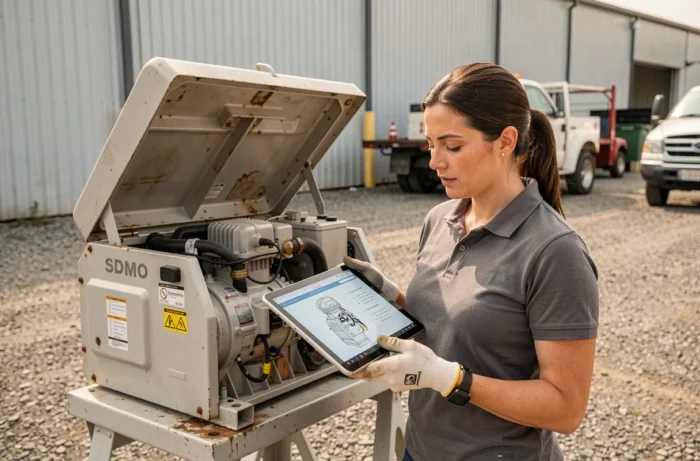
The exploded view is not only used for ordering. It also structures the diagnosis. Why? Because it forces you to reason by sub-assembly instead of replacing parts at random.
Your generator starts but the output voltage is unstable. Rather than immediately changing the AVR regulator, the exploded view of the alternator section allows you to first check the capacitor, then the stator connections, and then the regulator. Each component is visible in its mechanical context.
This methodical approach reduces the number of parts ordered unnecessarily. It also avoids intervening on an element without having identified those that hold it in place, which limits accidental breakages during disassembly.
A well-documented SDMO generator can be repaired faster and at a lower cost. The difficulty is never the replacement itself, but the correct identification of the part and its position. Keeping a copy of the exploded view corresponding to your exact series simplifies each intervention, whether you do it yourself or entrust it to a technician.