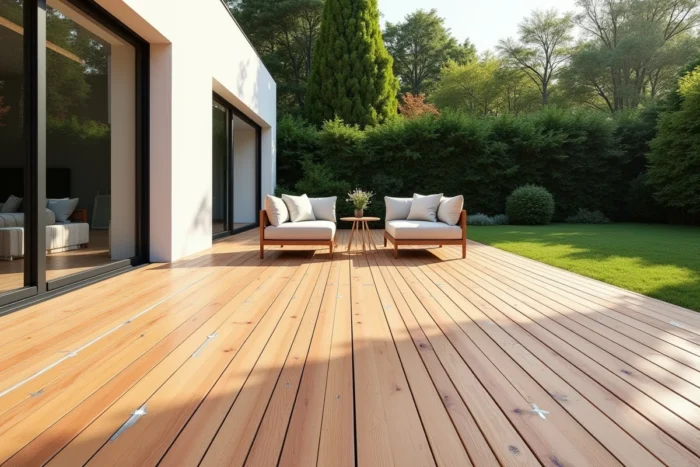
A terrace board installed outdoors undergoes repeated cycles of humidity, heat, and frost. The resistance to these stresses primarily depends on the wood’s service class, a standardized classification that determines its durability in a given environment. Choosing a suitable species means balancing this mechanical resistance, the acceptable level of maintenance, and the environmental impact of the material.
Service class and standard NF EN 335: the technical foundation to understand before any choice
The NF EN 335 standard defines five service classes, from 1 (wood indoors, never exposed) to 5 (permanent contact with saltwater). For an outdoor terrace, class 4 corresponds to the most common case: wood exposed to the elements with possible contact with the ground or freshwater.
Competing articles often recommend “class 3 or 4” without distinction. The nuance matters. A terrace on concrete pedestals, well-ventilated and without water stagnation, can function in class 3. In contrast, a terrace placed at ground level, by a pool, or in a very rainy region requires a minimum class 4 to avoid damage.
Before asking which wood to choose for an outdoor terrace, it is essential to qualify the installation configuration. This data filters the possible species.
Durable European species: black locust, chestnut, and larch versus exotic woods
The classic reflex is to oppose treated softwoods and exotic woods. This perspective overlooks a growing category: naturally durable European species.
Black locust and chestnut, local alternatives in class 4
Black locust (false acacia) is one of the few European woods classified naturally in class 4 without treatment. Its high density gives it a resistance comparable to certain tropical woods, with a much more favorable carbon footprint due to short supply chains.
Chestnut, also rich in protective tannins, reaches class 3 to 4 according to references. It grays over time, which some appreciate and others do not, but its mechanical performance remains stable over time.
Larch and Douglas fir: class 3 for ventilated terraces
These two European softwoods are positioned in class 3. Their price remains accessible, and their grain is appreciated for its character. They are suitable for elevated terraces, provided that ventilation under the boards prevents any water retention. Without this precaution, the risk of rot increases rapidly.
Ipé, cumaru, and exotic woods: maximum durability, traceability to verify
Ipé remains the benchmark for strength and longevity for terraces. Naturally class 5, it withstands the most aggressive environments. Cumaru offers a similar profile at a slightly lower cost.
The trade-off is environmental. The exploitation of tropical woods raises questions about deforestation. Requiring FSC or PEFC certification on these species is not a luxury; it is a minimum to ensure controlled forest management.
- Black locust and chestnut are the best naturally durable European options, suitable for most class 4 terraces.
- Larch and Douglas fir are suitable for elevated and well-ventilated configurations in class 3.
- Ipé and cumaru offer superior durability, but their choice must be accompanied by verification of forest certification (FSC or PEFC).
Maintenance of terrace wood: what each species really requires
The level of maintenance is often underestimated at the time of purchase. However, it determines the appearance of the terrace after a few seasons.
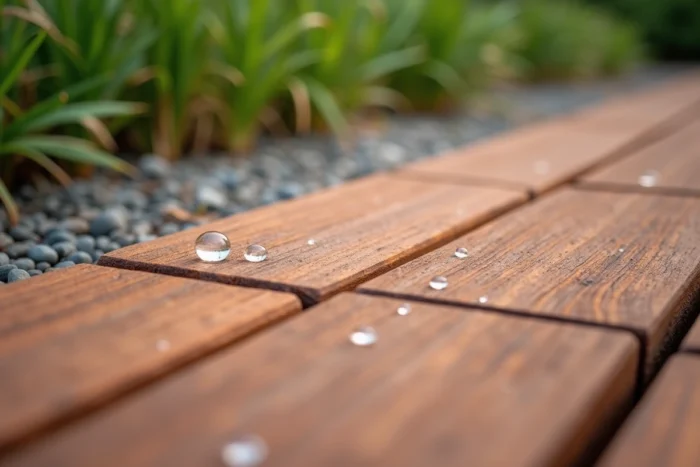
All natural woods gray under UV effects. This graying does not affect strength but changes aesthetics. To maintain the original color, a saturator must be applied once or twice a year. Dense exotic woods like ipé accept this treatment well. Softwoods, being more porous, require more frequent maintenance and regular cleaning to prevent moss.
Pressure-treated Scots pine (class 4 by treatment) represents the cheapest option. Its durability entirely depends on the quality of the treatment and maintenance. Without regular application of a protective product, it visibly deteriorates within a few years.
Natural wood or composite: selection criteria for a durable terrace
Composite (a mix of wood fibers and polymer resin) is not wood, but it occupies the same market. Its main argument: almost no maintenance and high resistance to graying.
The compromise lies elsewhere. Composite does not exactly replicate the feel or aging of solid wood. It heats up more in direct sunlight, which can pose a barefoot comfort issue in summer. Its price per square meter is in the high range, comparable to certified exotic woods.
- Choose natural wood if aging (graying, patina) is part of the desired aesthetics and if annual maintenance is feasible.
- Choose composite if the absolute priority is no maintenance, accepting a different feel and more significant temperature rise.
- Check the composition of the composite: products with a high proportion of recycled wood and recycled resin show a better environmental balance.
The choice of a terrace species rarely comes down to a matter of taste. The installation configuration dictates the necessary service class, and this class filters the possible species. Black locust deserves to be considered first for projects seeking to combine durability, short supply chains, and natural resistance before turning to exotics or composites.