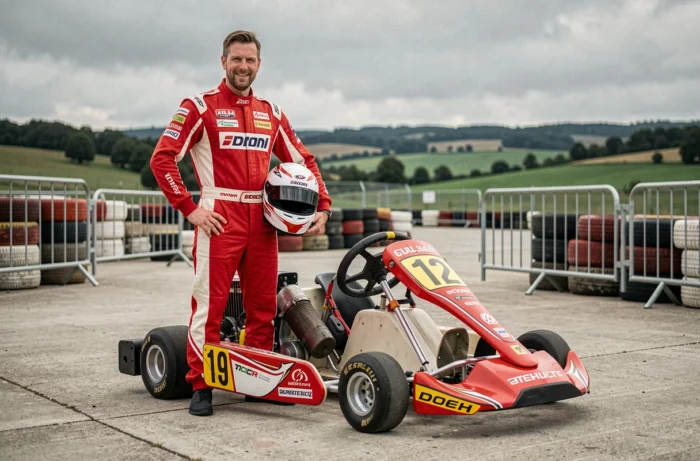
On a Sunday morning in a Walloon industrial zone parking lot, helmet under the arm and rental suit smelling of burnt rubber: this is often how a passion for motorsport begins in Belgium. Karting remains the most accessible entry point into this world, but the country offers much more than just a track and rental karts.
Licenses and Categories: What You Don’t Read on Booking Sites
Before talking about sensations, we need to discuss paperwork. In Belgium, the RACB Sport oversees national competitions in various automotive disciplines, from karting to rallying. To race competitively, you need a license issued by this federation.
License levels range from a basic permit for regional events to the “National C Circuit,” which grants access to races on tracks like Spa-Francorchamps or Mettet. Each license category imposes distinct medical and technical prerequisites. A sports medical certificate is not always sufficient: some categories require a fitness test.
For leisure karting, no license is required. Thus, we distinguish between two parallel worlds: indoor or outdoor karting in free sessions, and competitive karting with official lap times, technical scrutineering, and a starting grid. The tracks offered on andesmotorsport.be help to situate these different pathways and understand the bridges between leisure and competition.
Karting in Belgium: Outdoor Tracks vs. Indoor Circuits
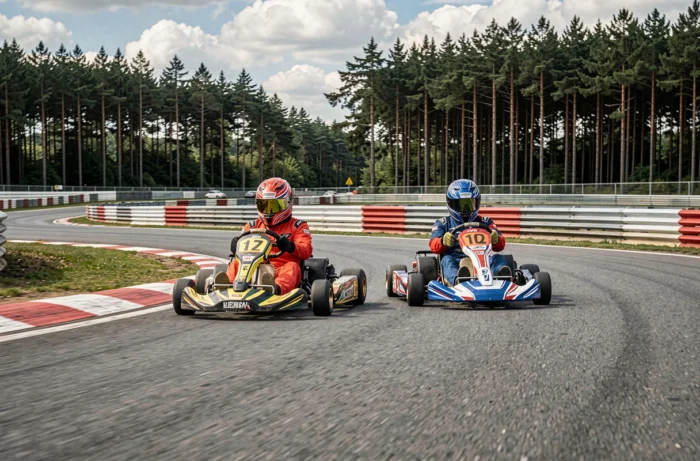
The choice of track radically changes the experience. An outdoor track like Spa-Francorchamps, with its layout of over a kilometer, exposes drivers to weather conditions. Rain, crosswinds, asphalt temperature: you learn to manage variables that indoor tracks completely eliminate.
Indoor is suitable for discovery, outdoor prepares for competition. Indoors, electric karts dominate. The instant torque of the electric motor provides strong acceleration, but the top speed remains limited. Outdoors, thermal karts (often 4-stroke engines for leisure, 2-stroke for competition) offer behavior closer to that of a real single-seater.
Victor Poiré, crowned indoor karting world champion, summed up the difference well in the Belgian press: comparing 4-stroke and 2-stroke is like comparing indoor soccer and grass soccer. The technical gesture is the same, but the physical constraints change everything.
What Distinguishes a Good Track
- The quality of the surface: a textured asphalt offers more grip than a painted or smooth surface, allowing for better trajectory control instead of suffering from slides
- The maintenance of the kart fleet: poorly adjusted karts (uneven tire pressure, unbalanced brakes) skew lap times and frustrate regular drivers
- The timing system: an individual transponder with real-time display allows for progress session after session, whereas a simple final ranking teaches nothing
From Karting to Car Racing: The Belgian Talent Detection Pathway
Belgium regularly produces drivers who break through internationally, and karting remains the foundation of this pathway. The RACB National Team identifies young talented drivers to guide them towards high-level motorsport.
The transition from karting to single-seater usually occurs between the ages of 14 and 16. You start with promotional formulas (Formula 4, for example), and then climb the ranks. The journey is long, costly, and opinions vary on this point: some families believe that a realistic annual budget for a young driver in national karting competition far exceeds what one might imagine.
Recent news illustrates the dynamics of the Belgian talent pool well. Red Bull has integrated Robin Räikkönen, the eleven-year-old son of Kimi Räikkönen, into its junior team. This type of early recruitment shows that major teams are monitoring karting rankings from the cadet categories.
On-Track Safety: Equipment and Standards to Know
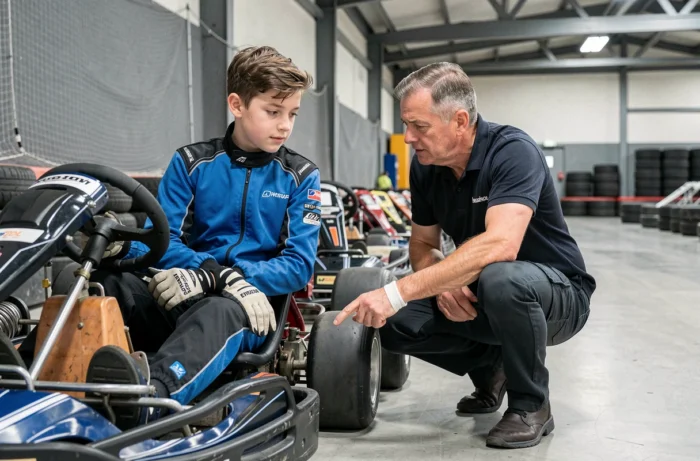
You don’t get on a kart like you hop on a bicycle. Even for leisure, a full-face helmet is mandatory, and most tracks require a suit, gloves, and closed shoes. In competition, the equipment must meet FIA-approved standards (fireproof suit, certified helmet).
The Belgian regulatory context is evolving towards stricter head protection in all motorized activities. Since September 1, 2026, a royal decree mandates the wearing of helmets for users of electric scooters exceeding 20 km/h. This measure, although not directly related to karting, establishes a stricter social norm around safety.
Checkpoints Before Each Session
- Ensure that the helmet fits properly (it should neither rotate on the head nor compress the temples) and that it has a valid certification
- Visually inspect the kart before starting: steering wheel securely attached, functional pedals, bumpers in place
- Follow flag signals: in Belgium as elsewhere, a black flag means an immediate return to the pits, not a suggestion
Belgian Motorsports: Disciplines Beyond Karting
Karting is just one facet. Belgium hosts rally, endurance, and circuit racing competitions throughout the year. The Zolder circuit notably organizes the 24-hour endurance race, a format that requires as much mechanical strategy as driving talent.
Rallying remains the most popular discipline in Wallonia. Regional events attract hundreds of spectators on forest roads, and rally driving courses (car control, weight transfers, hard braking) serve as additional training for drivers coming from karting.
Careers in motorsport also recruit beyond the driver’s seat. Mechanic, data engineer, team manager: each race mobilizes a complete team. For a young mechanic enthusiast, joining a local team as a volunteer during a regional championship round remains the best way to understand the real workings of a race weekend.
The next time you put on a helmet at a Belgian track, you’ll at least know what ecosystem you’re stepping into. Karting is a starting point, not an end in itself.