Wild purslane (Portulaca oleracea) colonizes warm, dry, and poor soils with formidable efficiency. Eliminating purslane in the garden without resorting to chemical products requires understanding what makes this weed so tenacious, and then choosing the method suited to each situation. Let’s compare the available approaches before identifying those that produce lasting results.
Comparison of Natural Methods Against Purslane
Not all chemical-free techniques are equal. The table below ranks the main options according to their long-term effectiveness, practicality, and ability to prevent regrowth.
| Method | Immediate Effectiveness | Prevention of Regrowth | Effort Required |
|---|---|---|---|
| Repeated False Seedings | Low (delayed action) | High | Moderate |
| Early Manual Pulling | High | Medium | High |
| Targeted Boiling Water | High | Low | Low |
| Thick Mulching (Organic) | Medium | High | Moderate |
| Thermal Weeding (Flame) | High | Low | Moderate |
This comparison highlights a clear gap between methods that destroy the visible plant and those that reduce the seed bank in the soil. Purslane produces seeds in massive quantities, capable of remaining viable in the ground for several years. A purely curative approach (pulling, boiling water) requires restarting each season.
To learn how to eliminate purslane in the garden sustainably, one must combine action on the existing plants with a strategy to reduce the seed stock.
False Seedings Against Purslane: The Method That Targets the Seed Stock
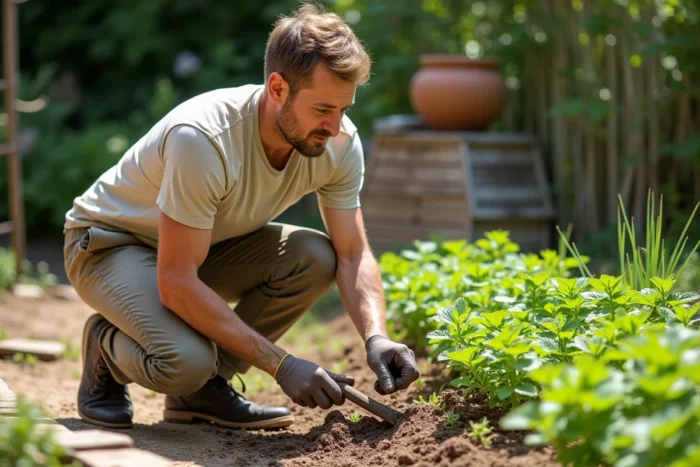
False seeding is now recommended in organic market gardening as a reference method against annual weeds such as purslane. The principle is simple: prepare the soil finely, water it to trigger germination, and then mechanically destroy the seedlings before planting the crops.
For purslane, the intervention occurs at the two to four leaf stage, with a shallow pass of the hoe. The seedlings, still fragile, have no recovery capacity at this stage.
Why This Approach Surpasses Traditional Pulling
Manual pulling targets adult plants, often already in the process of fruiting. At this point, each manipulated plant disperses seeds onto the ground, which fuels the problem for the following season. False seeding, on the other hand, eliminates seedlings before any seed production.
Two to three cycles of false seeding before spring planting are sufficient to significantly reduce purslane pressure on a plot. The soil retains fewer viable seeds from year to year.
Pulling and Boiling Water: Real Effectiveness and Limits
Pulling remains the first reaction of most gardeners when faced with purslane. Its effectiveness entirely depends on the timing chosen.
- Intervening before flowering (stems still tender, no visible capsules) greatly limits seed dissemination in the soil.
- Pulling after seed formation amounts to sowing purslane oneself, as the capsules open at the slightest contact.
- Stem fragments left in the ground can re-root due to the succulent nature of the plant, which requires completely collecting every pulled piece.
Boiling cooking water (from pasta, potatoes) is a documented alternative for targeted thermal weeding. Poured directly onto purslane plants, it destroys plant cells through thermal shock. Potato cooking water, rich in starch, forms a film that partially smothers regrowth.
Precautions to Take with Boiling Water
The water must not be salted, as salt degrades soil structure and harms microorganisms. This method is suitable for paths, borders, and paved areas. On growing beds, it risks damaging the roots of neighboring plants if poured imprecisely.
Mulching and Ground Cover: Blocking Light to Prevent Germination
Purslane needs light to germinate. A sufficiently thick organic mulch (straw, wood chips, dead leaves) deprives the seeds of this light signal and limits germination.
For mulching to be effective against purslane, the layer must be dense and uniform. A mulch that is too thin or irregular allows enough light to pass through to permit germination. Conversely, well-laid mulch after an initial manual weeding reduces the workload throughout the season.
Woven Fabric or Organic Mulch
Woven mulch fabric blocks light more reliably than organic mulch, but it does not nourish the soil. Organic mulch, on the other hand, improves soil structure as it decomposes, which promotes a denser competing flora over the seasons. In a vegetable garden, combining the two (fabric between rows, organic mulch at the base of plants) provides a solid result.
Why Not Throw Pulled Purslane on the Compost
The reflex to compost pulled weeds poses a specific problem with purslane. The succulent stems retain their ability to recover even after being pulled, and the seeds withstand the heat of a standard home compost. Throwing purslane into the compost amounts to reintroducing the seeds into the garden during spreading.
The solution is to let the pulled plants dry on an impermeable surface (concrete, plastic tarp) for several days in full sun, until completely desiccated. Once perfectly dry, the residues can join the compost without risk of recovery.
Sustainable elimination of purslane relies on the combination of two distinct actions: destroying existing plants before their fruiting and reducing the seed stock through false seeding or opaque mulching. No isolated method is sufficient, but two to three seasons of combined management significantly reduce the pressure.