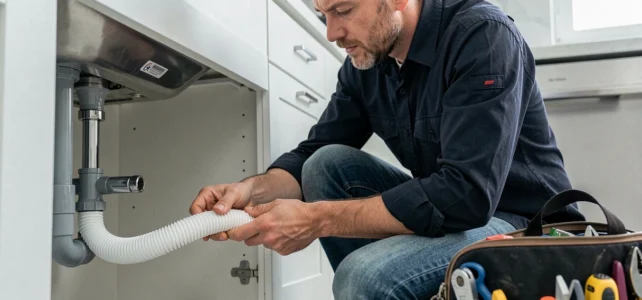
When installing a dishwasher in an already equipped kitchen, connecting the drainage to the sink’s siphon often poses more problems than the water supply. A poorly positioned drainage hose or an undersized siphon is enough to cause backflow from the very first cycles. Here’s how to approach this connection while considering the real constraints of an existing installation.
Shared drainage diameter: the trap of the original siphon
Most kitchen sinks are equipped with a siphon that has a 40 mm diameter outlet. As long as the sink drains alone, this size is more than sufficient.
The problem arises as soon as a dishwasher is connected to the same line. Two devices draining simultaneously through a 40 mm pipe create a blockage, especially if the pipe has a bend or a significant length before the wall drop. Recent professional practice in France consists of upgrading from a 40 mm to a 50 mm diameter for the shared drainage pipe, precisely to handle this double flow without the risk of backflow.
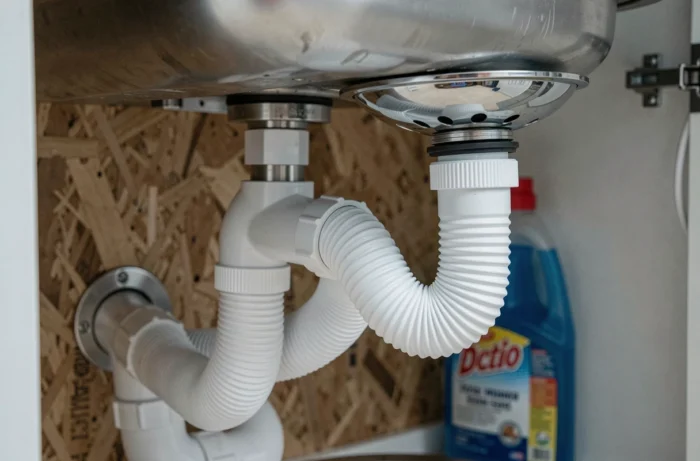
The existing siphon is replaced with a model that has a 50 mm outlet equipped with a connection for the dishwasher. This type of siphon can be found in any plumbing section. Before purchasing, check the diameter of the wall outlet: if it is also 40 mm, a reducing sleeve should be planned or, better yet, adapt the drop.
A good connection of the dishwasher drainage to a sink starts with this diameter check, which most online guides forget to mention.
High point of the drainage hose: the anti-backflow loop
You connect the drainage hose to the siphon, and you think it’s done. This is where dirty water backflows and bad odors begin.
The dishwasher drainage hose must rise to a high point before descending to the siphon. This loop, mechanically fixed under the countertop, prevents sink water from flowing back into the machine by simple gravity. Without it, every drainage of the sink risks sending greasy water back into the dishwasher.
The recommended height for this high point is just below the countertop. The hose is fixed with a clamp screwed into the side of the cabinet, not just wedged. A hose that slips and loses its high loop cancels all anti-siphoning protection.
Maximum connection height on the siphon
In parallel with the high loop, the connection to the siphon itself should not exceed about 50 cm from the floor to avoid straining the drainage pump. Beyond that, the dishwasher’s pump struggles to drain the water, which lengthens the cycles and prematurely wears out the component. You end up with a machine that does not drain completely, leaving stagnant water at the bottom of the tub.
If the sink’s siphon is positioned higher (in the case of raised sinks or high countertops), a direct connection to the wall drop should be considered instead of the siphon.
Y-connector or side inlet of the siphon: which setup to choose
There are two options for physically connecting the drainage hose to the sink’s drainage circuit.
- The siphon with integrated side inlet: this is the cleanest solution. You replace the existing siphon with a model that has a grooved outlet onto which you directly fit the dishwasher drainage hose. The connection is watertight and only requires a clamp on the outlet.
- The Y-connector (or T-connector): it is interposed between the siphon and the wall drop. This solution is suitable when you want to keep the existing siphon, but it adds an additional junction point, thus a risk of leakage if the seals are not properly sized.
- The direct connection to the wall drop, without going through the siphon: reserved for configurations where the distance between the dishwasher and the sink exceeds one meter. You drill the drop to insert a specific connector, but this setup requires more precision and a good adjustment of the slope.
In most kitchens, the siphon with a side inlet remains the most reliable setup. Feedback varies on the Y-connector, which can vibrate and loosen over time if the clamp is not tight enough.

Installation errors that cause leaks and odors
You can follow the connection diagram and still have problems. Here are the most common on-site errors.
Drainage hose too long or too bent
The hose supplied with the dishwasher is generally between 1.5 and 2 meters. You might be tempted to extend it with a sleeve if the machine is far from the sink. Each extension and each added bend reduces the pump’s drainage capacity. Beyond 2 meters of total length, drainage becomes incomplete.
Crushed or missing siphon seal
When disassembling and reassembling the siphon to install the side inlet, you sometimes forget to replace the flat seal between the siphon body and the outlet. A reused seal that has taken the shape of the old setup no longer guarantees watertightness. Always buy a new set of seals with the siphon.
Absence of a non-return valve
Some dishwashers have a non-return valve in their drainage pump. Others do not. If the machine does not have one and the high loop is not properly maintained, water from the sink will flow back into the machine with each drainage. Check the manufacturer’s manual to see if an external valve is recommended.
The connection of a dishwasher’s drainage to a sink depends on three technical parameters: a drainage diameter suitable for the double flow, a properly fixed high loop, and a connection height that does not exceed the pump’s capacity. Neglecting any of these points exposes you to backflows or drainage failures within the first weeks of use.